Showing posts with label Training. Show all posts

Thursday, May 5, 2011

Fueling the Mind


As a quick aside before I get into this post, can I just say that I am positive I eat about more bugs per capita, per year, than most other people out there! Granted, I don't actually WANT to eat these bugs, but I swear, if my mouth is open (which if I'm on the bike, then I'm talking, so it probably is, or even running) they find a way strait to the back of my throat where I promptly swallow them. Once they get in there, you really don't have a choice.. you're getting some free protein - yuck, yuck, yuck.

Now that THAT's over, let's spend a moment talking about fueling the mind. Many people talk to me (and I talk to them) about fueling their body with the right foods and fluids to succeed, but how much attention do you pay to your mental attitude and training? How much do you think it plays a role in your race day?

I can honestly say that I believe a majority of the time we spend working out is fraught with mental messages, from our bodies (of course) giving us the usual, this hurts, I'm tired, I want to stop, can't we sit down etc. However, it's also filled with to-do lists, did I feed ____ (insert dog, kids, wife etc.), what will I have for dinner and the list goes on and on. That's normal, we're human, we need to use this time out on the road riding, or between the lane lines to find some peace, sort through problems or just hear the silence.

With that said, I also think paying more attention to this side of things can make a decent athlete better, and a good athlete great. I've been very fortunate over the years. I've been an athlete most of my life and coaches from high-school cross country to college have spent time giving me the tools and the knowledge to put some really important aspects of the mental game into practice. However, some of that, I do believe, is also something innate. It can be taught, and you can change your mental game, but it's not going to come easily. If you've always been a negative self talker "I'm not a good swimmer, I stink at hills, I just can't run fast no matter what I do" then guess what - say a little hello to my friend - self fulfilling prophecy - because you're going to be doing just that.

I couldn't help of think of Sally Meyerhoff who recently passed away after colliding with a pickup truck while bicycling in Maricopa, Arizona. Not only an amazing athlete, but someone who really inspired me with her attitude to be a better athlete and person. While my workout load has been growing, and my sleep and time for myself has been waning I've been tempted to sway from my usual self lately and talk myself out of this interval or that pace during more than one workout. Each time I've come back to Sally and her description as "relentlessly positive" or to some of my other athlete friends making it happen on a daily basis, or even a facebook message someone would write saying that my little posts inspired them or helped them in some way. So I'd go back to one thing:

Not

Giving

Up

I worked through the tough parts, and took those negative thoughts and shoved them way down. During workout one the three, I would promise myself not to think of the next, until I had put every last thing into the current workout. I would talk to myself prior when my body said "I'm tired!" my mental game would say back "I'll just have to go to bed earlier tonight" because there are no excuses on race day. You either have it, or you don't. I'd rather spend my time in workouts pushing the envelope when it needs to be pushed than wonder "what if?".

So, my advice to my athletes and to anyone who will list is really always the same

Stay relentlessly positive like Sally

Don't Give Up

Don't look for excuses, look for ways to overcome

Train with flexibility, be willing to adapt

Injured? What CAN you do? - then do it.

Listen to the voices that tell you the right things, the things you need to hear, ignore the rest

Practice your mental game in training, over and over, remember what worked on race day and use it

I leave you with some pictures from my last few weeks.. they are my life in a nutshell at times!
Mom on the spin bike during her first voyage
Rear view of the four mile race - GO MOM!
Yep, this guy was cool - and wearing bunny ears too!
The amazing pool at the YMCA. Oh my love.. my darling
Sweet, sweet Betty Designs Water Bottle that I won from Chloe! Thanks C- I LOVE IT!
The view I've been seeing a LOT lately (it feels like college!)
The guy we bumped into on our ride.. seriously, this is your mailbox holder?? What are you thinking?
Lisa and I out on our Sat. ride when it was SUNNY! YES - SUN IN PITTSBURGH - what a concept!
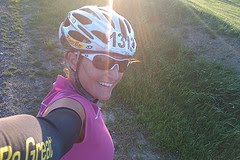
Riding hills makes me happy
A stream I ran by last week in the woods

I'm thankful, and I have a good life. Thanks for listening..

Friday, March 4, 2011

Protein? Do Athletes Need More?


Proteins

If you hang around with athletes long enough, you will always hear them discussing certain topics, and protein is one of them. Male bodybuilders will obsess over everything from what types or amounts of protein are the best to the timing of their protein intake. Endurance athletes won't talk about it quite that much. However, they certainly pay attention to it, and rightfully so! Making sure you have enough protein as part of an overall healthy diet is important to help rebuild muscle tissue that sustains tears during intense physical training.

What is protein for? Here are a few key things:
  • It provides essential amino acids, which are the building blocks of cells.
  • It aids in the development of new tissues, and allows the growth and repair of damaged tissues.
  • It helps produce important enzymes that are essential for rebuilding our system, not to mention hormones and other antibodies to keep our immune system healthy.
  • It transports substances in the blood
  • It keeps the fluid balance of our bodies in check
  • It provides very minute amounts of energy during exercise (especially endurance exercise)
Are the needs of athletes higher than the general population?

YES! Athletes do need more protein than those who are not training for an event. Certain phases of training may even require more than others. If you are trying to build more muscle during the off-season, this could be a time of heavy strength training and therefore, increased protein needs. However, while getting enough protein is certainly important to do all the functions mentioned above, protein in excess is still excess calories, and therefore, will be stored as fat if it is not able to be used to build or repair muscle tissues etc.

Calculating Your Protein Needs

Daily protein needs are dependent on two things, your body weight and your amount / type of training. If you participate in a moderate aerobic exercise routine (e.g., you work out for fitness, workout 3-4 days per week for 30-60 minutes per day), then your protein needs are at least 0.5 grams of protein per pound. This would produce a need of around 100 grams per day for a 200 pound athlete.

However, as you start working out harder, your needs also increase. During a competition phase, where you are both training and competing, you may have longer workouts of 60 mins+ on more days of the week than not. Your body needs additional protein in this phase for building new muscle and maintaining current muscle mass. Protein needs during this phase can be as high as 1.0 grams per pound. For that same 200 pound athlete, this would be closer to 200 grams per day. Intakes higher than 1.0 grams per pound have not be shown to be beneficial for athletes, and should be avoided due to additional stress on the kidney / excess possible weight gain.

Using a number somewhere in the middle of these two (0.5 grams per pound and 1.0 grams per pound), depending on your phase of training, is a good place to start.

What are good sources of high quality protein?

There are plenty of options when it comes to high quality protein, and they don't have to be expensive or hard to find. Below you will find some great examples of items to include in your diet.

Protein Sources:

  • Eggs
  • Skim or Low fat milk
  • Beans
  • Lean Meats (look for ground beef that is 90% lean)
  • Cottage Cheese
  • Canned Tuna or chicken
  • Textured Vegetable Protein
  • Peanuts, Almonds or other nuts
  • Low fat cheeses, like mozzarella or cheddar

When choosing meats, always go for the lower fat versions with less marbling and skinless turkey or chicken breast. Protein can also be found in grains and vegetables, but the amount is smaller. In addition, iron from meat sources is more available to our bodies, so it is a good idea to consume meat sources for that reason as well. The best idea is to vary your protein sources to allow you to obtain many different nutrient sources, vitamins and minerals. By including different types of proteins in your diet you have a better overall protein balance, not to mention you don't get sick of any one type.

Staying at your best involves attention to detail and some planning, but it certainly is worth it in the end. If you have additional questions, I suggest you contact a Registered Dietitian who can help you design a more specialized protein plan to fit your needs.

Feel free to leave comments! I would love to hear from you!